

Why Choose a Wood Humidor Box for Your Business?
A Wood Humidor Box can give your business a practical, premium storage solution for legal, humidity-sensitive products. It protects quality while creating a stronger presentation at the point of sale. For retailers, hospitality brands, and specialty distributors, storage is part of the customer experience.
Solid wood offers natural insulation and a warm visual appeal. Spanish cedar is often selected because it supports stable humidity and adds a distinctive aroma. A reliable box should include tight joints, a calibrated hygrometer, and a properly fitted seal. These details matter during daily handling, especially when products move between warehouses, display counters, and delivery vehicles.
It is not just decoration.
Experienced buyers should inspect construction carefully. Thin panels may look attractive but can respond quickly to temperature changes. Poorly calibrated gauges can also create false confidence. Regular monitoring remains necessary, even with quality materials. A Wood Humidor Box requires maintenance, including seasonal adjustment and gentle cleaning. That responsibility is sometimes underestimated.
Businesses should also consider legal compliance, responsible marketing, and age-appropriate sales procedures where applicable. Product claims need support from manufacturers, testing records, or recognized industry guidance. Sustainable wood sourcing can strengthen credibility, but vague environmental language should be questioned. A well-designed box can improve product preservation, brand perception, and customer trust. Yet it will not solve every storage problem. Its value depends on honest specifications, trained staff, and consistent care.
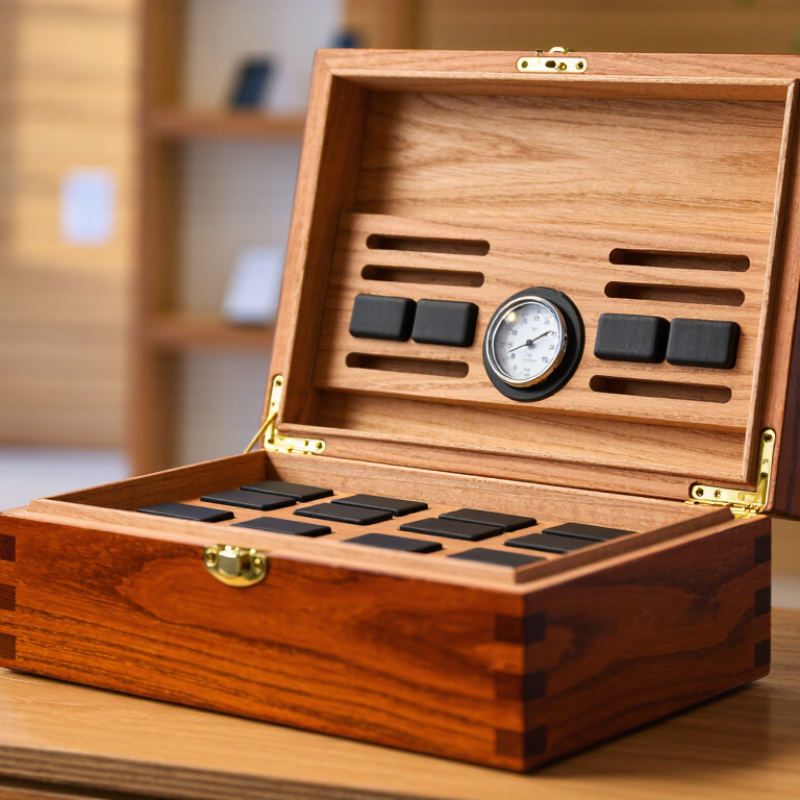
Define Cigar Storage Needs: 65–72% RH and 18–21°C
A wood humidor box gives business inventory a controlled, presentable environment. Its wooden walls help soften rapid changes in humidity and temperature. However, wood cannot regulate conditions by itself. A reliable hygrometer remains essential for daily checks.
For cigar storage, aim for 65–72% relative humidity and 18–21°C. This range supports stable texture, aroma, and burn performance. Humidity below the target can dry cigars and make them brittle. Excess moisture may encourage uneven burning, mold, or swollen wrappers. Temperature also matters. A warm storage room can increase humidity swings and damage consistency.
Before loading stock, inspect the box seal and season the interior gradually. Place the hygrometer at cigar level, not beside the humidification source. Check readings at the same time each day. Small changes are easier to correct than sudden recovery efforts. Keep the box away from windows, heaters, and air-conditioning vents. The location matters more than many teams expect.
In practical storage work, regular records reveal problems early. Write down humidity, temperature, and corrective actions. Do not rely on one perfect reading. Sensors can drift, and wooden boxes respond slowly. I have seen teams adjust too quickly, creating larger swings. A calmer approach works better. Stable conditions, clean handling, and careful rotation help protect product quality and support customer confidence.

Why Choose a Wood Humidor Box for Your Business?
Proper cigar storage requires a stable relative humidity of 65–72% and a temperature of 18–21°C. A quality wood humidor box helps buffer short-term environmental changes and maintain conditions that support cigar freshness, aroma, and aging.
Evaluate Spanish Cedar for Aroma, Pest Control, and Moisture Stability
Why Choose a Wood Humidor Box for Your Business?
Spanish cedar offers more than a warm, traditional aroma. Its scent can create a refined opening experience when customers inspect stored products. The wood also absorbs and releases moisture gradually, helping reduce sudden humidity changes inside the box. This matters for businesses managing valuable, humidity-sensitive inventory. Stable conditions may support better texture, appearance, and long-term consistency.
It is not a magic shield. Spanish cedar may discourage some common pests, but it cannot replace cleaning, inspection, or proper storage practices. In my experience, overly strong cedar can also affect aroma balance. A new box should be aired and conditioned carefully before regular use. Use a reliable hygrometer, and record readings during seasonal changes. Small records reveal problems early. Results can vary with room temperature, wood thickness, and seal quality. That uncertainty deserves attention.
Tips: Choose kiln-dried, untreated Spanish cedar with a clean surface. Avoid scented coatings or questionable finishes. Condition the interior slowly, rather than adding excessive moisture at once. Check corners and hinges for dust every month. Keep the box away from direct sunlight, heaters, and damp walls. If humidity remains unstable, inspect the seal before blaming the wood. A well-made wooden humidor supports professional presentation, but daily maintenance protects the investment.
| Evaluation Dimension | Spanish Cedar Characteristics | Practical Data or Typical Range | Business Benefit | Assessment | Important Limitation |
|---|---|---|---|---|---|
| Aroma Contribution | Releases a warm, woody aroma containing naturally occurring aromatic compounds that can complement tobacco during storage. | Perception is subjective and depends on wood age, surface area, ventilation, and storage duration. Aroma is usually strongest when the interior is newly constructed or freshly exposed. | Creates a recognizable premium presentation and may support a traditional humidor experience. | High sensory value | Excessive or unconditioned wood aroma may overpower delicate products. Odor intensity cannot be guaranteed as a fixed measurement. |
| Moisture Buffering | As a hygroscopic wood, Spanish cedar absorbs and releases water vapor as surrounding relative humidity changes. | Common cigar-storage targets are approximately 65%–72% relative humidity, depending on product requirements. Wood moderates short-term fluctuations but does not regulate humidity by itself. | Helps reduce rapid humidity swings and provides a more forgiving internal environment than a non-porous box alone. | Strong buffering support | A humidification device, accurate hygrometer, airtight construction, and regular maintenance are still required. |
| Dimensional Stability | Spanish cedar expands and contracts with changes in moisture content, as do all natural woods. | Seasoned, properly kiln-dried wood is more predictable than green or poorly dried wood. Actual movement depends on grain direction, thickness, finish, and humidity changes. | Stable construction helps doors, trays, and lining components maintain better fit during normal operating conditions. | Good when properly prepared | Unsealed end grain, rapid humidity changes, and oversized solid panels can contribute to warping, gaps, or sticking. |
| Natural Pest Deterrence | The characteristic cedar scent is associated with compounds that can deter some insects, including certain moths and beetles. | Deterrence is dependent on aroma concentration, enclosure design, pest species, and exposure time. It is not equivalent to a quantified insecticide treatment. | Adds a passive protective feature without requiring routine chemical treatment inside the storage box. | Useful supplementary feature | Spanish cedar is not pest-proof. Inspection, sanitation, controlled humidity, and quarantine procedures remain necessary for commercial storage. |
| Typical Density and Handling | Lightweight to medium-density hardwood with a relatively open structure, making it practical for interior linings, trays, and dividers. | Air-dry density is commonly reported at approximately 0.40–0.60 g/cm³, depending on species, origin, and moisture content. | Provides a balance between manageable shipping weight, workable machining, and a substantial wood interior. | Business-friendly material | Density varies between boards; design calculations should use verified supplier specifications for the selected stock. |
| Compatibility with Stored Products | Traditionally used for cigar storage because its aroma and moisture interaction are generally compatible with tobacco products. | Product response varies with tobacco blend, wrapper, packaging, storage time, and target humidity. A trial batch is advisable before large-scale deployment. | Supports differentiated packaging, gift boxes, retail displays, and long-term product presentation. | Well suited for cigar use | Products with neutral or delicate aromas may absorb wood odors, so odor testing should be part of quality control. |
| Conditioning Requirement | The interior wood should reach a suitable moisture balance before products are loaded. | Allow conditioning time based on box size, wood thickness, construction quality, and humidity system. Do not rely solely on a short surface wipe or an unverified humidity reading. | Reduces the risk of the box drawing moisture from stored goods during initial use. | Essential operating step | Over-wetting can cause swelling, mold risk, or finish damage. Use a calibrated hygrometer and controlled humidification. |
| Maintenance and Service Life | Can provide long service life when protected from liquid water, extreme humidity changes, and mechanical damage. | Inspect seals, hinges, hygrometer accuracy, interior odor, mold, and pest activity at regular intervals. Maintenance frequency depends on climate and usage. | Supports repeatable customer experience and reduces avoidable product losses. | Good long-term potential | Wood quality alone cannot compensate for poor sealing, incorrect humidification, or unsuitable storage conditions. |
| Recommended Commercial Use | Best suited as an interior lining, tray, divider, or carefully selected solid-wood component in a controlled humidor design. | Use moisture-resistant construction practices, consistent board thickness, reliable seals, and quality-control testing before production release. | Combines visual appeal, traditional aroma, humidity buffering, and a premium tactile experience. | Strong overall option | Performance depends on the complete system: wood preparation, box design, humidification, sealing, calibration, and operating procedures. |
Apply ASTM D4442 to Verify Wood Moisture Content
Why Choose a Wood Humidor Box for Your Business?
Apply ASTM D4442 to Verify Wood Moisture Content
A wood humidor box depends on stable moisture, not attractive grain alone. Excess moisture may cause swelling, warped panels, or uneven joints. Low moisture can create shrinkage and visible gaps. These defects affect fit, appearance, and product protection. ASTM D4442 provides recognized test methods for directly measuring moisture in wood and wood-based materials. It supports more defensible quality decisions than a quick visual inspection.
A practical inspection begins with representative samples from different boards and production batches. The laboratory should identify each sample, remove surface contamination, and record its condition. A calibrated balance measures the wet mass before testing. The sample then follows the applicable ASTM D4442 procedure, commonly involving controlled drying and repeated weighing. Testing continues until the mass becomes stable. The final calculation compares moisture loss with the original wet mass.
Keep the records clear.
Document the test date, sample location, equipment calibration, drying conditions, and calculated moisture percentage. Use the current ASTM edition and a trained technician. An electrical meter can support fast screening, but it should not replace a suitable reference method. Wood species, density, temperature, and surface condition can affect meter readings. One reading can mislead. In our experience, sampling too close to an end grain sometimes produces confusing results. That limitation deserves review, not concealment. A documented ASTM D4442 process helps businesses set practical moisture specifications and investigate failures with greater confidence.
Compare Wood Humidors by Capacity, RH Control, and Service Life
Why Choose a Wood Humidor Box for Your Business?
Capacity, humidity control, and service life should guide a wood humidor purchase. A larger box is not automatically better. Measure usable interior space, not advertised exterior volume. Trays, dividers, and thick walls reduce storage capacity. For retail operations, removable trays can improve counting, rotation, and cleaning. A 50-unit box may hold fewer products after proper spacing and airflow are considered.
Relative humidity, or RH, needs closer attention. ISO 3402:2023 specifies 22 ±1°C and 60 ±2% RH for tobacco conditioning tests. Commercial storage may use a different target, often near 65–72% RH, depending on the product and operating policy. The box should include a calibrated hygrometer, reliable sealing, and a humidification system suited to its internal volume. Check RH at several points, not only near the lid. Uneven readings reveal weak airflow or poor placement. Small digital sensors can also drift. That detail is easy to overlook.
Wood affects long-term performance. The USDA Forest Products Laboratory’s Wood Handbook explains that wood exchanges moisture with surrounding air, causing dimensional movement. Stable construction, properly seasoned wood, sealed joints, and regular inspection can extend service life. Avoid placing the box beside heaters, windows, or air-conditioning vents. I have seen operators focus on appearance and ignore calibration. That choice becomes expensive later. A practical evaluation should record RH recovery time, hinge strength, seal condition, and interior volume over several months.
Measure Business Value Through Inventory Protection and Operating Costs
Why Choose a Wood Humidor Box for Your Business?
Measure Business Value Through Inventory Protection and Operating Costs
A wood humidor box can protect lawful cigar inventory from unstable humidity and sudden temperature changes. In daily operations, small climate shifts can create noticeable losses. Dry leaves may crack, while excess moisture can affect texture, aroma, and packaging. A tight-fitting lid and reliable seal help reduce these risks. Cedar interiors can also support steady moisture distribution when properly maintained.
The details matter.
Inventory protection is only half the calculation. Operating costs include humidification supplies, electricity, cleaning time, repairs, and product waste. A well-built box may require a higher initial investment. However, it can reduce frequent adjustments and emergency replacements.
Staff can check one calibrated hygrometer instead of monitoring several weak storage units. That saves time during busy receiving and counting periods.
Maintenance still requires discipline. Wood can absorb moisture, swell, or develop surface damage in poor conditions. We learned that placing a humidor near a loading door created unnecessary fluctuations. The box was not the only problem. Location mattered.
Businesses should record humidity readings, inspect seals, and rotate stock by arrival date. A simple log can reveal whether the container is saving money or hiding avoidable costs.
Not every wooden humidor delivers equal value. Construction quality, capacity, and daily handling must match the inventory.

