Why Choose a Box Filling Machine for Your Business?
Choosing a box filling machine is a practical decision, not a fashionable upgrade. It can improve packing speed, product consistency, and workplace safety when matched to the right operation. A bakery may need gentle handling for fragile pastries. A hardware supplier may require accurate counting and strong carton support. The machine must fit the product, box size, filling pattern, and daily production volume.
Jorge Izquierdo, Vice President of Market Development at PMMI, offers a useful principle: “Automation should address a specific business need, not chase technology for its own sake.” That idea matters here. A box filling machine can reduce repetitive lifting, limit spillage, and create steadier output during busy shifts. It may also connect with conveyors, weighing systems, labeling equipment, and quality checks. However, automation is not automatically efficient. Poorly chosen tooling can cause jams, long changeovers, and expensive downtime.
Real experience should guide the purchase. Measure current packing time, labor requirements, error rates, and product damage before comparing machines. Ask suppliers for demonstrations using your actual boxes and products. Check cleaning access, operator training, spare parts, warranty coverage, and service response times. These details often matter more than a polished brochure.
There are trade-offs.
A box filling machine needs investment, floor space, and regular maintenance. Smaller companies may prefer a semi-automatic model before adopting a fully automated line. That choice can be less impressive, but more realistic. The strongest decision combines measurable savings, operator feedback, and honest planning. Technology should support the business, not complicate it.
What Is a Box Filling Machine?
Why Choose a Box Filling Machine for Your Business?
What Is a Box Filling Machine?
A box filling machine is equipment that places measured products into boxes or cartons. It may handle powders, granules, small parts, or packaged goods. The machine typically combines product dosing, box positioning, filling, and basic quality checks. Some models also close or label the box.
Not just a hopper.
Inside the system, sensors detect each box before filling begins. A dosing unit then releases a programmed quantity. This helps reduce uneven weights and product waste. Operators can adjust settings for different box sizes and materials. In food or cosmetic production, cleanable surfaces and controlled contact areas are especially important.
The machine does more than save labor. It creates a repeatable filling method that production teams can monitor. Written procedures, routine inspections, and accurate weighing still matter. A poorly calibrated sensor can cause repeated errors, even when the machine looks efficient. That detail matters.
From practical experience, the best choice depends on product texture, box dimensions, speed, and cleaning needs. Fragile items may require gentler handling. Dusty materials may need enclosed sections and extraction equipment. Businesses should also check changeover time, spare parts access, operator training, and applicable safety requirements. The first setup may feel slower than manual packing. Later adjustments can reveal whether the machine truly fits the workflow.
How Does a Box Filling Machine Work?
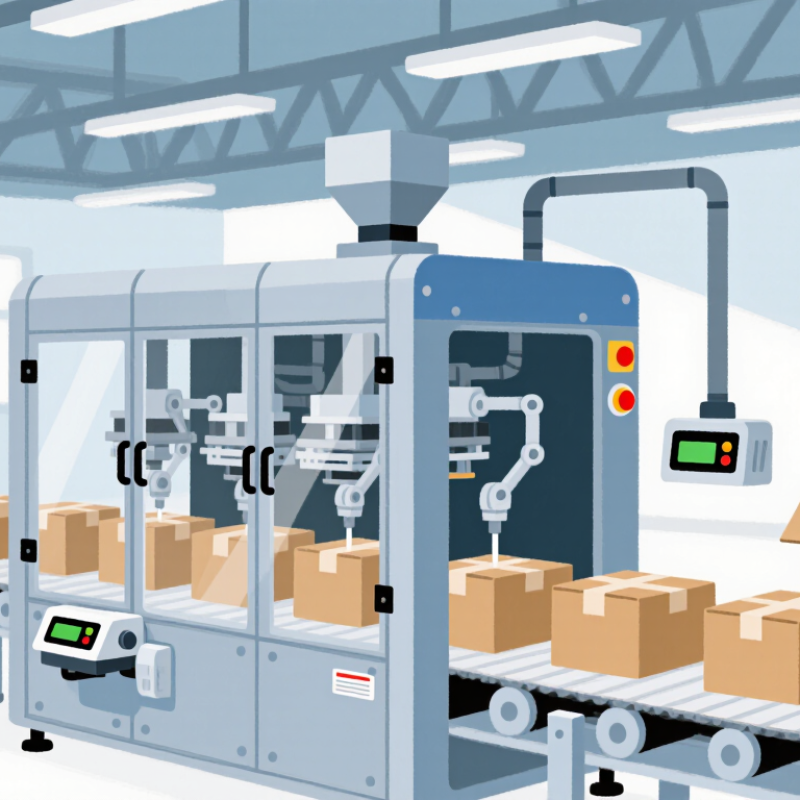
A box filling machine automates the movement, filling, and closing of cartons in a controlled production cycle. An operator places empty boxes onto a conveyor or loading station. Guides square each box before a sensor confirms its position. This alignment matters. A crooked carton can cause spills, jams, or uneven weight.
The machine then opens the carton and holds it with side clamps or folding arms. A measured product dose enters through a hopper, auger, pump, or weighing system, depending on the material. Load cells may check the filled weight before the box moves forward. Sensors monitor box presence, fill level, and conveyor timing. If a reading falls outside the set range, the controller can pause the line for inspection. The flaps are folded and sealed with adhesive or tape. Clean contact surfaces support reliable sealing.
In real facilities, performance depends on more than speed. Operators must adjust settings for different box sizes, product textures, and humidity levels. Powder may bridge inside the hopper, while loose items can settle unevenly. Small errors matter. Regular cleaning, calibration, and sensor checks reduce these problems. Still, automation is not perfect. A worn guide rail or poorly formed carton can interrupt the entire cycle. Experienced staff should review rejected boxes instead of simply restarting the machine. That habit often reveals issues that the control panel cannot explain.
What Products Can It Handle?
Why Choose a Box Filling Machine for Your Business?
What Products Can It Handle?
A box filling machine can handle many products, depending on its feeding system and box design. Common examples include bottles, cans, jars, pouches, cartons, trays, and sealed bags. It can also arrange small household items, packaged snacks, personal care products, and hardware components. Product shape matters. Smooth, regular items usually move faster than flexible or uneven ones.
Some machines use conveyors, robotic pickers, or guided lanes to place products into boxes. A conveyor can move sealed pouches steadily, while a robotic arm may handle fragile jars with controlled movement. Adjustable guides support different product widths. Sensors can check product presence and reduce empty boxes. These details help operators maintain consistent packing during busy production hours.
However, one machine rarely handles every product perfectly. Sticky packages may slow the feed, and soft bags can collapse during loading. Very small items may need a special counting system. Changeovers also require time, tools, and careful testing. That part is easy to underestimate. In practical use, operators should test real products, full boxes, and different production speeds before choosing equipment. A machine may perform well in a demonstration but behave differently beside a dusty conveyor or during a rushed shift. Human inspection still matters, especially when packaging quality affects customer trust.
What Business Benefits Does It Provide?
Why Choose a Box Filling Machine for Your Business?
A box filling machine can make daily packing faster, steadier, and easier to control. On a busy line, workers may repeatedly place products into cartons for several hours. That repetition can cause fatigue, uneven loading, and slower output near the end of a shift. Automated filling helps maintain a consistent rhythm, especially when box sizes and product weights are clearly defined.
The business benefits are practical. A machine can reduce manual handling, improve packing accuracy, and support more predictable labor planning. It may also lower product damage caused by rushed placement. For example, a controlled filling cycle can position items evenly before sealing. This creates cleaner cartons and fewer packing adjustments. Production records can reveal cycle times, stoppages, and material usage, which helps managers make better decisions.
However, automation is not a magic fix. Poorly matched equipment may create delays instead of removing them. Product shape, carton strength, line space, and cleaning requirements all deserve careful testing. A small trial with real products can expose problems that a sales sheet misses. Staff training matters too. Experienced operators should still inspect fills, adjust settings, and respond to unusual items. The best results usually come from combining reliable machinery with thoughtful human oversight.
Why Choose a Box Filling Machine for Your Business?
Automated box filling can improve throughput, reduce labor requirements, lower material waste, and shorten changeover time. The chart shows representative operational changes compared with a manual packing process.
Illustrative benchmark based on a typical packaging operation: 180 boxes per hour manually versus 600 boxes per hour with automated filling; labor time, material waste, and changeover time are shown as percentage reductions.
How Should You Choose the Right Machine?
Choosing a box filling machine starts with your real production conditions, not a catalog photograph. Measure box dimensions, product weight, fill pattern, and hourly demand. According to PMMI’s 2024 State of the Industry report, labor availability remains a major concern for packaging operations. Automation may reduce repetitive handling, but only when the machine matches your workflow.
Check the numbers carefully. A machine rated for 30 boxes per minute may achieve less with fragile products, frequent size changes, or manual feeding. PMMI reports that packaging companies continue investing in automation to improve efficiency and manage labor pressure. Ask for a factory trial using your products. Observe jams, changeover time, cleaning access, and operator movement. Small delays become expensive across a long shift.
Do not ignore integration. The filler should communicate with upstream conveyors, checkweighers, and case sealers. Review safety guarding, emergency stops, electrical standards, and service response before signing. The International Federation of Robotics recorded 541,302 industrial robot installations globally in 2023, showing how quickly automation is expanding. Still, more automation is not always better. A simpler machine may be easier to maintain and more reliable for smaller batches. I would also calculate total ownership cost, including spare parts, energy, training, and downtime. The cheapest quotation can age badly.
Why Choose a Box Filling Machine for Your Business? - How Should You Choose the Right Machine?
| Evaluation Dimension | Manual Box Filling | Semi-Automatic Filling | Automatic Box Filling | Recommended Selection Consideration |
|---|---|---|---|---|
| Typical output rate | Approximately 5–20 boxes per minute, depending on the product and operator | Approximately 15–50 boxes per minute, depending on the feeding and dosing method | Approximately 30–120+ boxes per minute for standardized products and packaging | Compare the required hourly output with the machine’s tested speed using your actual product and box format |
| Labor requirement | High; operators generally handle product loading, filling, and box movement | Moderate; operators usually load boxes or product and monitor the filling cycle | Low to moderate; staff are mainly needed for loading materials, inspection, and replenishment | Estimate labor savings together with training, maintenance, and material-handling needs |
| Filling consistency | Most dependent on operator technique and manual measurement | Generally more consistent when a calibrated dosing system is used | Usually the most consistent option when the product is uniform and the machine is correctly configured | Specify the required fill-weight tolerance and confirm accuracy through product trials |
| Suitable product types | Small batches, mixed products, irregular items, and products requiring frequent handling | Powders, granules, liquids, solid pieces, and products with moderate production variation | Standardized products with stable flow, size, weight, and packaging requirements | Select the filling principle according to product behavior: auger, volumetric, piston, net-weight, or counting |
| Box size flexibility | Very high; operators can usually adapt quickly to different box sizes | Moderate to high; format changes may require guides, tooling, or recipe adjustments | Moderate; best results are achieved with defined box dimensions and repeatable formats | List the smallest and largest box dimensions and ask for changeover details before purchasing |
| Initial investment | Lowest equipment cost, but higher recurring labor cost | Moderate equipment cost with a balance between automation and manual operation | Highest equipment cost, often justified by larger volumes and repeatable production | Evaluate total cost of ownership rather than purchase price alone |
| Changeover needs | Fast for small changes, but dependent on operator skill | Typically requires adjustment of guides, filling settings, or dosing components | May require programmed settings, tooling changes, and cleaning procedures | Choose equipment with accessible parts, stored recipes, and clearly defined changeover steps |
| Floor-space requirement | Low | Moderate; space is needed for the dosing unit and operator access | Moderate to high; conveyors, feeders, sealers, and inspection systems may be integrated | Measure available length, width, height, utilities, access routes, and maintenance clearance |
| Hygiene and cleaning | Simple to clean, but direct manual contact can be greater | Improved process control with removable or accessible product-contact parts | Can reduce direct handling, provided the machine is designed for suitable access and sanitation | Confirm food-contact materials, cleaning access, dust control, and applicable regulatory requirements |
| Best business fit | Start-ups, seasonal production, prototypes, and low-volume operations | Growing businesses seeking better consistency without a fully automated line | High-volume operations with stable products, predictable demand, and consistent packaging | Match the automation level to demand stability, product variation, and expected business growth |
| Key questions before purchase | Can the operator maintain the required output and accuracy? | How long do adjustments and cleaning take between products? | Can the machine integrate with conveyors, sealers, checkweighers, and inspection equipment? | Request a product test, written specifications, utility requirements, maintenance schedule, and spare-parts information |
Note: Output figures are typical planning ranges rather than guaranteed performance. Actual results vary according to product characteristics, box dimensions, fill weight, dosing method, operator skill, and line configuration. Final specifications should be confirmed through a trial using the intended product and packaging.
Related Posts
-
Top Box Filling Machines for Efficient Packaging Solutions?
-
How to Use a Pouch Up Bag for Convenient Organization and Travel?
-
Top Vegetable Processing Equipment You Should Know About?
-
Top Fruit Processing Equipment for Efficient Production Solutions?
-
How to Choose Bag in Box Filling Equipment?
-
Why Choose the Best Fruit Juice Processing Equipment for Your Business?