How to Choose Bag in Box Filling Equipment?

How to Choose Bag in Box Filling Equipment?

Choosing bag in box filling equipment is a practical decision, not simply a search for the fastest machine. Product viscosity, filling temperature, bag dimensions, closure type, and hygiene requirements all influence performance. A thin juice may fill smoothly, while a particulate sauce can expose weak valves, narrow tubing, or inaccurate flow meters.

Industry data shows why this category deserves careful evaluation. Smithers’ report, The Future of Bag-in-Box Packaging to 2028, identifies continued demand for efficient flexible packaging and larger-volume liquid formats. Its analysis connects growth with lower material use, transport efficiency, and improved dispensing convenience. PMMI’s 2024 industry research also highlights labor shortages, automation, and equipment flexibility as important packaging investment drivers. These trends affect more than production speed. They influence training time, maintenance access, changeover losses, and long-term operating costs.

The details matter. A reliable bag in box filling equipment solution should provide repeatable fill accuracy, controlled sealing, and documented sanitation procedures. It should also match the plant’s actual output, rather than an ideal number shown in a brochure. Not always.

In practice, operators should test real product samples before approving a machine. A five-liter bag filled with chilled concentrate can behave very differently from a warm, low-viscosity liquid. Ask suppliers for trial results, reference installations, spare-parts support, and validation records. Consider aseptic, hot-fill, or ambient filling requirements separately. A cheaper machine may become expensive after frequent film adjustments and unplanned downtime. Yet no spreadsheet captures every production surprise. Careful testing remains essential.
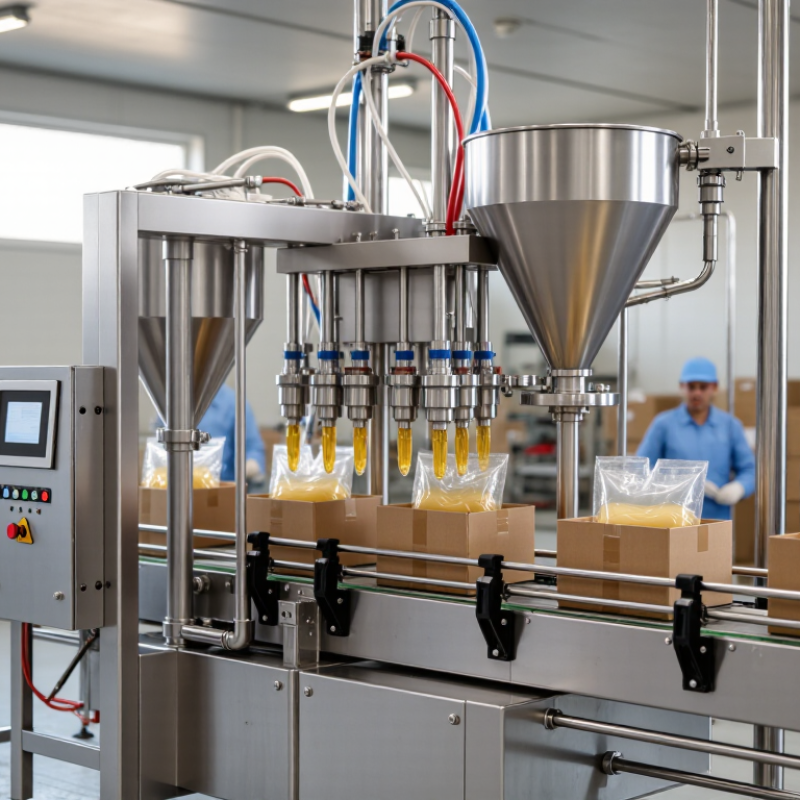
How to Choose Bag in Box Filling Equipment?

Define Product and Pack Range: 1–20 L Retail or 200–1,000 L Bulk Bags

How to Choose Bag in Box Filling Equipment?

Start by defining the product, package size, and expected production rhythm. A 1–20 L retail bag needs different equipment from a 200–1,000 L bulk bag. Check viscosity, temperature, acidity, particulates, and foam behavior before selecting the filler. Water-like liquids may fill quickly, while thick sauces require stronger pumps and wider product paths. Fruit pieces can complicate valves and increase product damage. Small retail bags usually need accurate dosing, clean sealing, compact conveyors, and flexible changeovers. Operators often underestimate changeover time. That mistake affects daily output.

Bulk filling demands a different mindset. Large bags need stable support, controlled flow, and reliable weighing during filling. The frame must handle the bag’s loaded weight without excessive movement. Consider bag dimensions, spout position, pallet layout, and forklift access. A 1,000 L bag can change the entire factory workflow. Filling accuracy still matters, but speed must not weaken seals or create air pockets. Ask suppliers for trials using your actual product and packaging. Test the difficult product, not only water.

Tips: Record three production targets: bags per hour, filling tolerance, and acceptable product loss. Request cleaning procedures, calibration guidance, and maintenance access. Check whether one machine can cover your full pack range. It may not. A smaller filler can be more practical for retail packs, while bulk production may justify dedicated equipment. Review samples after storage and transport, because a good filling result is not always a reliable package.

Match Filling Technology to Viscosity, Particles, Oxygen, and Aseptic Needs

How to Choose Bag in Box Filling Equipment?

Match Filling Technology to Viscosity, Particles, Oxygen, and Aseptic Needs

Bag-in-box equipment should match the product, not just the package size. Thin juices may need high-speed volumetric filling with steady flow control. Thick sauces require stronger pumps and wider product paths. Products with fruit pieces or grains need gentle handling and larger valves. I have seen small particles bridge narrow fittings, causing uneven fills and avoidable downtime. Measure viscosity at actual processing temperature. A cold product can behave very differently.

Tips: Test real product samples before choosing equipment. Check particle size, pump shear, fill accuracy, and cleaning access. Watch the product during startup, not only under stable conditions. Small details matter.

Oxygen-sensitive products need controlled deaeration, low-splash filling, and reliable bag evacuation. Headspace management can protect flavor and color, but it should be verified with oxygen testing. Aseptic applications demand more than sterile-looking equipment. They require validated sterilization, controlled zones, suitable materials, and consistent sealing performance. Review the complete process path, including connectors and filling nozzles. One overlooked surface can weaken the entire hygiene plan. In practice, specifications are sometimes too optimistic. A pilot run may reveal foaming, dripping, or seal distortion that documents miss. Choose equipment that can be adjusted without compromising repeatability. Keep records of trials, cleaning results, and fill-weight checks.

How to Choose Bag in Box Filling Equipment? - Match Filling Technology to Viscosity, Particles, Oxygen, and Aseptic Needs

Product Condition Typical Operating Range or Requirement Recommended Filling Technology Suitable Pump or Metering Method Key Equipment Features Main Risks and Selection Notes
Low-viscosity, particle-free liquids Approximately 1–100 mPa·s; examples include water-like beverages, liquid ingredients, and clear sauces Pressurized product tank, sanitary centrifugal pump, or low-pulsation positive-displacement pump Fast filling Simple flow path High repeatability
Use load cells or a calibrated mass-flow meter when fill-weight control is critical.
Excessive pressure or turbulence can increase foaming and oxygen pickup, especially in carbonated or protein-containing products.
Medium-viscosity liquids Approximately 100–5,000 mPa·s; examples include syrups, dressings, liquid concentrates, and many dairy or plant-based products Progressive-cavity, lobe, rotary-vane, or other sanitary positive-displacement pump Controlled flow Gentle product handling Recipe flexibility
Provide jacketed tanks or heated product lines if viscosity changes significantly with temperature.
Pump speed, line diameter, temperature, and back pressure must be matched to prevent shear, air entrainment, or unstable fill times.
High-viscosity or shear-sensitive products Approximately 5,000–100,000 mPa·s; examples include thick sauces, fillings, gels, and concentrated pastes Piston, lobe, progressive-cavity, or servo-driven pump selected through product trials High torque Large sanitary valves Short product path
Use hopper agitation, jacketed piping, and slow-start controls where required.
Do not size equipment from viscosity alone. Yield stress, thixotropy, temperature, trapped air, and pressure sensitivity can change the actual filling behavior.
Products containing soft or suspended particles Particles commonly range from about 1–10 mm, depending on shape, concentration, and product fragility Wide-passage lobe pump, progressive-cavity pump, or carefully selected piston system Large-bore fittings Gentle acceleration Minimal restrictions
Specify a product path with adequate clearance and avoid abrupt changes in direction.
Particle size alone is not sufficient for selection. Evaluate particle hardness, aspect ratio, concentration, settling rate, and allowable breakage during a filling trial.
Products with very fine suspended solids Typically less than 1 mm; examples include pulpy beverages, spice suspensions, and fine particulate sauces Lobe, progressive-cavity, or low-shear centrifugal pump, depending on viscosity and solids loading Tank agitation Recirculation loop Anti-settling control
Use a bottom-outlet tank design where settling is likely.
Keep solids uniformly suspended without introducing excessive air. Validate the first and last bags in a production run for composition consistency.
Oxygen-sensitive products Low dissolved oxygen or low headspace oxygen required; common for oxidation-sensitive beverages, fruit preparations, and some liquid foods Low-pulsation sanitary pump with controlled speed and stable back pressure Nitrogen or sterile-gas purge Closed product path Low-splash nozzle
Consider deaeration before filling and controlled evacuation or purge of the bag headspace where compatible with the package.
Oxygen control depends on the complete process, including raw materials, tank design, seals, piping, filling speed, bag barrier properties, and storage conditions—not only the filler.
Hot-fill products Often filled at approximately 80–95°C, but the correct temperature depends on the product, package, and validated process Heat-compatible sanitary positive-displacement or centrifugal pump Heated hopper or lines Temperature monitoring Heat-resistant seals
Use a validated cooling, handling, and storage procedure after filling.
The bag film, fitment, cap, and sealing system must be rated for the actual product temperature and exposure time. Hot-fill temperature is product-specific and must be validated.
Aseptic or commercially sterile products Requires validated sterility or commercial-sterility control from product treatment through filling and closure Sanitary positive-displacement or centrifugal pump integrated with the validated aseptic process Sterile product path Packaging decontamination HEPA-filtered air Validated CIP/SIP
Include monitoring of temperature, pressure, sterile air, chemical concentration, exposure time, and closure integrity as applicable.
A standard hygienic filler is not automatically aseptic. The entire system, packaging material, utilities, cleaning, sterilization, and operator procedures require documented validation.
Foaming or gas-releasing products Products that foam during pumping or filling; examples include detergents, protein beverages, fermented liquids, and carbonated products Low-shear pump with variable-speed control; avoid unnecessary recirculation Gentle start/stop Reduced free fall Foam detection
Use larger-diameter lines and smooth transitions to reduce pressure drop and turbulence.
A faster filler is not always better. Excessive velocity, sharp restrictions, and suction-side air leaks can increase foam and reduce net fill accuracy.
Small laboratory or pilot-scale bags Typical fill volumes from approximately 0.5–20 L, depending on the application Peristaltic pump for low-throughput flexibility; piston or mass-based filling for improved repeatability Quick changeover Low product hold-up Recipe adjustment
Prioritize cleanability, data logging, and compatibility with multiple bag sizes.
Peristaltic tubing is a consumable and may limit pressure, temperature, or solvent compatibility. Confirm tubing life and accuracy at the target flow rate.
Medium and large commercial bags Commonly approximately 5–25 L for foodservice and industrial use; larger formats may require specialized handling Sanitary centrifugal or positive-displacement pump selected for viscosity and particle content Load-cell platform Automatic tare Drip-free closure
Use bag support, controlled nozzle withdrawal, and accessible change parts for safe handling.
Large bags amplify errors caused by unstable product density, temperature variation, and bag positioning. Verify net weight after conditioning and during routine production.
Frequent product changeovers Multiple recipes, allergens, colors, or viscosity levels processed on the same line Pump and valve arrangement selected to minimize hold-up volume and dead legs Tool-less change parts CIP capability Recipe management
Specify drainability, hygienic design, accessible seals, and documented cleaning parameters.
Changeover time is determined by the whole system, not just the filler. Include tanks, hoses, manifolds, bag connectors, cleaning chemicals, rinse water, and verification procedures.
Engineering ranges in this table are typical starting points rather than universal limits. Final equipment selection should be confirmed through product trials using the actual formulation, temperature, particle profile, bag size, fitment, required throughput, cleaning method, and regulatory process requirements.

Size Throughput from 10–60 Bags per Minute and Required OEE Targets

How to Choose Bag in Box Filling Equipment?

Selecting filling equipment starts with the required output, not the highest advertised speed. A small operation may need 10 bags per minute, while a large line may target 60. Bag volume, product viscosity, pouch design, and changeover time affect the real rate. A 20-bag-per-minute system may outperform a faster machine when it produces fewer rejects. Measure the full process.

OEE gives a more honest target. It combines availability, performance, and quality. For many new installations, an initial OEE target of 70–75% is practical. Mature lines may reach 80–85% with stable materials and trained operators. Higher targets require evidence. My first production estimate was too optimistic because cleaning and film adjustments consumed more time than expected.

Tips: Record actual bags per minute during filling, sealing, cleaning, and format changes. Ask for test data using your product, bag size, and filling temperature. Check whether the quoted 60 bags per minute excludes stoppages. A useful trial should report output, downtime, rejects, and operator interventions. Leave capacity headroom, perhaps 15–20%, for seasonal demand and slower batches. Do not size equipment only for today’s order volume. A line running continuously near its limit may suffer more seal faults and maintenance delays. Review the target after several weeks of production, because early OEE numbers can be misleading.

How to Choose Bag-in-Box Filling Equipment?

Nominal throughput and required Overall Equipment Effectiveness (OEE) targets for bag-in-box filling lines operating from 10 to 60 bags per minute.

Higher-speed equipment requires stronger uptime, faster changeovers and stable material handling. The OEE targets shown are practical planning benchmarks: OEE combines availability, performance and quality, while actual results depend on bag size, product viscosity, changeover frequency and operator practices.

Verify Fill Accuracy, CIP/SIP Design, and FDA 21 CFR or EU 1935/2004 Compliance

When selecting bag-in-box filling equipment, begin with evidence rather than attractive specifications. Fill accuracy affects yield, customer trust, and downstream sealing. Ask for repeatability data at your actual product temperature and viscosity. Test several bag sizes, not only the easiest one. Weigh filled bags over repeated cycles, then compare results against your allowed tolerance. Small errors accumulate.

CIP and SIP design deserves close inspection. The product path should drain completely, with smooth welds and minimal dead legs. Check spray coverage, flow velocity, cleaning chemical compatibility, and documented cleaning temperatures. For SIP, verify steam exposure, pressure control, and cold spots near valves or seals. Request recorded cycle data, not verbal assurances. A beautiful system can still clean poorly.

Compliance requires material-level verification. FDA 21 CFR and EU 1935/2004 are not interchangeable approval stamps. Confirm declarations for every product-contact plastic, elastomer, adhesive, and lubricant. Keep traceability records for changes and replacement parts. Ask whether testing reflects your food type, temperature, and contact duration. Operators should also review hygienic access, calibration records, and software controls. In practice, documentation may be incomplete or too generic. That weakness should be challenged before purchase, not discovered during an audit.

Compare Automation, Labor, Utilities, Maintenance, and Total Cost of Ownership

How to Choose Bag in Box Filling Equipment?

Compare Automation, Labor, Utilities, Maintenance, and Total Cost of Ownership

Choosing bag-in-box filling equipment starts with production reality, not a feature list. A highly automated filler can reduce repetitive labor and improve dosing consistency. However, it may require skilled technicians, specialized training, and higher upfront investment. Manual or semi-automatic systems cost less initially, but staffing needs can rise during long shifts. Small details matter. Consider operator movement, filling speed, changeover time, and the number of people needed per line.

Utilities also affect the purchase decision. Compressed air demand, electrical consumption, water use, and ventilation requirements should be measured under normal production conditions. A machine that appears efficient on paper may perform differently when pumps run continuously. Ask suppliers for operating data, then compare it with your facility’s actual utility costs. Estimates are useful, but they are not perfect.

Maintenance deserves equal attention. Accessible filling heads, standard wear parts, clear alarms, and simple cleaning procedures can reduce downtime. Record the cost of filters, seals, valves, calibration, service visits, and planned stoppages. Total cost of ownership should include installation, training, spare parts, energy, labor, repairs, and lost production. A lower purchase price can become expensive after several years. Yet the opposite can happen too: automation may be unnecessary for seasonal output. Review real production volumes, not optimistic forecasts, and leave room for honest uncertainty.